-
-
-
-
-
Connecting Housing, Transportation + Education to Expand Opportunity: Living, Learning + Moving Together
In many parts of the country it is difficult for families, particularly low- or moderate- income families to afford a suitable home in a transit-rich neighborhood with good schools. This report synthesizes the ideas and policy recommendations from a national convening of local, state, and federal stakeholders from across the country on innovative policy and…
-
Engaging Students in Transforming Their Built Environment via Y-PLAN: Lessons from Richmond, California
This field report describes how high school students from Richmond, California used an innovative educational strategy called Y-PLAN (Youth – Plan, Learn, Act, Now) to actively participate in the planning and transformation of their school, neighborhoods and city. Our description follows students through the five-step YPLAN process, highlighting how they effectively challenged the ways in…
-
Going It Alone: Can California’s K-12 School Districts Adequately and Equitably Fund School Facilities?
After decades of dedicated investment, state funding to assist local California school districts in the construction, modernization, and maintenance of their school facilities has come to a halt. Our analysis of school facility spending across California finds that, compared to industry standards, there is an ongoing, structural pattern of inadequate and inequitable spending in many…
-
Guided By Principles: Shaping the State of California’s Role in K-12 Public School Facility Funding
K-12 public school facilities need regular investment to ensure student health and safety and support educational programming. Yet, the future of K-12 school facility funding in California is uncertain. A strong state-local partnership has existed that funded new construction, modernization, and other investments in public school facilities across the state since 1998, under the School…
-
State Funding for K-12 School Facilities: A Survey of the States
California lawmakers are debating the future of the state’s role in providing school construction and modernization funds to local school districts – a school facility funding role the state has played since 1947. Previous statewide school construction bond authority is exhausted. To inform this policy debate, our paper describes the role each of the 50 states plays…
-
-
-
-
WEBINAR: Healthy School Facilities: Planning for ‘Good Repair’ in Local Control Accountability Plans // A Primer for Parents, School Board Members and Community Advocates (April 3, 2014)
Under California’s new Local Control Funding Formula (LCFF) K-12 funding system, Local Control and Accountability Plans (LCAPs) must address “school facilities in good repair. ” (as defined in California Education Code § 17002d). This webinar will give participants the knowledge and tools to actively participate in their school districts good repair plan. (Sponsored by The…
-
A Policy Framework for Joint Use: Enabling and Supporting Community Use of K–12 Public School Facilities
Joint use of public school facilities is a complex but manageable approach to efficiently enhancing the services and programs available to students and supporting the community use of public schools. Building upon on our 2010 paper Joint Use of Public Schools: A Framework for a New Social Contract, this paper identifies the policy framework needed…
-
Joint Use of Public Schools: A Framework for Promoting Healthy Communities
Despite the growing interest in expanding the joint use of K–12 public schools by public health and planning practitioners to promote healthy, sustainable communities, the topic has received little attention in the urban planning and public health scholarship. The objective of this article is to situate joint use in the academic literature focused on the…
-
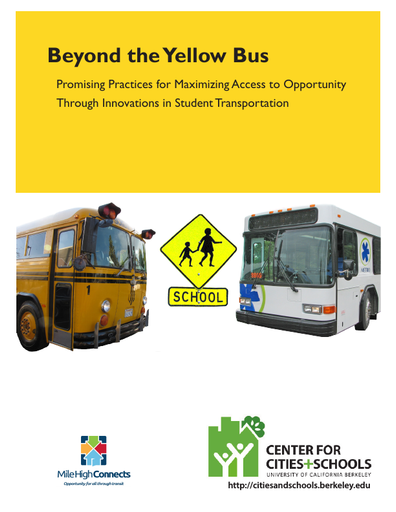
Beyond the Yellow Bus: Promising Practices for Maximizing Access to Opportunity Through Innovations in Student Transportation
Access to safe, affordable, and convenient transportation shapes the ‘geography of opportunity’ for many children and youth. This study looks at howlocalities across the country are implementing new and innovative alternative approaches to student transportation that expand regional transportation access for K-12 students, improve cost-effectiveness, and leverage inter-agency partnerships beyond the traditional yellow school bus.
-
School Facilities Cost Calculator: A Joint-use Tool for Fair Fees
The School Facilities Cost Calculator: A Joint-Use Tool for Fair Fees, a free tool that helps school districts and communities determine the costs of owning and operating their facilities and develop a fair and transparent joint-use fee structure, is now available in an interactive web-based format. The Cost Calculator includes rich data from nearly 15,000…
-
Putting Schools on the Map: Linking Transit-Oriented Development, Households with Children, and Schools
Transportation Research Record: Journal of the Transportation Research Board, Volume 2357, pgs 77-85 Abstract Transit-oriented development (TOD) remains a popular strategy to achieve environmentally sustainable infill development and auto use reduction. Typically, TOD in the United States offers retail amenities and housing catering to single individuals, childless couples, and empty nesters. Municipal and regional leaders…
-
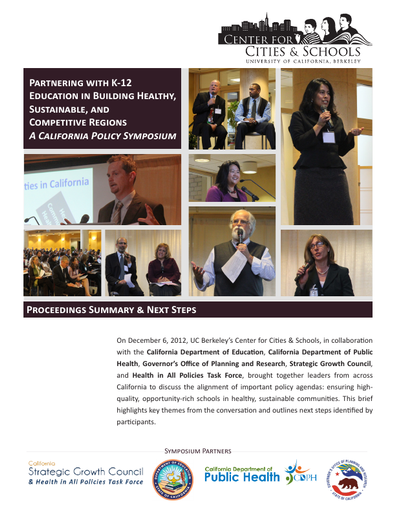
Partnering with K-12 Education in Building Healthy, Sustainable, and Competitive Regions: A California Policy Symposium
On December 6, 2012, UC Berkeley’s Center for Cities & Schools, in collaboration with the California Department of Education, California Department of Public Health, Governor’s Office of Planning and Research, Strategic Growth Council, and Health in All Policies Task Force, brought together leaders from across California to discuss the alignment of important policy agendas: ensuring…
-
Fair, Transparent and Equitable: Recommendations for K-12 Joint Use Facilites Fee Structure in San Francisco
SFUSD, like many districts, allows use of its classrooms, gymnasiums, and other indoor facilities to external groups. But similar to other districts, SFUSD has struggled to apply use fees consistently, fairly and equitably. Building from the recommendations of the 2010 report, San Francisco’s Public School Facilities as Public Assets: A Shared Understanding and Policy Recommendations…


End of content
End of content